

Vinzala Institute Model
Your child shouldn’t have to adjust to the system.
The system should adjust to your child.
Vinzala is built as an adaptive learning model that adjusts to each student’s pace, level of understanding, and developmental needs—so progress is based on mastery, not fixed schedules or grade-level timing.
Six Core Learning Domains
Vinzala does not attempt to reinvent education from scratch. Instead, the learning model draws from the strongest instructional practices developed across high-performing education systems around the world — combining proven ideas into a single modern learning framework.
 Singapore
 Japan
JapanMathematics
Anchored in Singapore mastery sequencing, Japanese problem-solving pedagogy, and IB-style upper-level modeling.
Students build mathematical reasoning through concrete-to-visual-to-abstract progression, structured problem solving, data reasoning, and modeling rather than memorization alone.
Focus Areas
SingaporeJapan Finland
Science
Combining Singapore’s structured science, Japan’s observation-first inquiry, Finland’s phenomenon-based learning, and IB/NGSS practices.
Students learn science as observation, investigation, evidence, modeling, explanation, and research — with engineering applications coordinated with Technology.
Focus Areas
Singapore Canada
 England
Reading & Writing
Built from Singapore reading/viewing, Ontario structured literacy, England phonics and transcription-composition foundations, and upper-level international academic literacy demands.
Students build decoding, fluency, comprehension, spelling, mechanics, technical communication, documentation, and independent authorship through an integrated literacy spine supported by wide reading and purposeful writing.
Focus Areas
 Estonia
 United States
Technology, Engineering & AI Systems
Inspired by Estonia’s digital society and ProgeTiiger model, modern U.S. AI/tool ecosystems, and future-facing engineering practice.
Students learn to use intelligent tools to build, test, secure, automate, simulate, and explain digital and engineered systems — not merely memorize coding syntax.
Focus Areas
SingaporeCritical Thinking
A framework-led reasoning spine using Paul-Elder, visible thinking routines, Cambridge-style thinking skills, digital inquiry, and IB TOK habits.
Students learn to evaluate claims, evidence, assumptions, AI outputs, sources, models, and decisions before accepting or acting on information.
Focus Areas
JapanSingaporeUKCharacter Development
Drawing from Japan’s Tokkatsu and Dotoku, Singapore CCE, UK PSHE, and IB CAS-style service and reflection.
Character is treated as daily practice: self-regulation, responsibility, integrity, collaboration, leadership, and ethical use of powerful technology.
Focus Areas
The 3-Hour Academic Model
How can six learning domains fit into just three focused hours each day?
Traditional schools divide the day into long fixed subject blocks. Students may spend an hour on a subject even when they already understand it, then run out of time where they actually need guided practice.
Vinzala compresses the academic morning into a focused three-hour mastery block. The current baseline gives Math, Science, and Technology equal 35-minute technical blocks, then supports literacy, reasoning, and character through shorter daily blocks designed for high focus and rapid feedback.
Vinzala works differently.
Learning time is intentionally allocated, not divided evenly. The baseline schedule is Math 35, Science 35, Technology 35, Reading 20, Writing 20, Critical Thinking 20, and Character Development 15 minutes, with early-literacy levels adjusting Reading/Writing to 25/15 when needed.
“When learning adapts continuously to a student’s level of mastery, time is used more effectively. In many cases, students can progress faster because time is spent where it actually matters.”
What happens to other subjects like history, arts, and culture?
These areas are not removed—they are integrated.
Students encounter them through afternoon workshops, collaborative projects, research tasks, and real-world applications where knowledge is used in context rather than taught in isolation.
Critical Thinking & Character Development
At Vinzala, Critical Thinking is a formal daily subject and also a cross-subject reasoning layer. Character Development is a planned daily formation block supported by routines, workshops, and coach observation.
Both domains matter more in an AI-native school because students must learn not only what to think, but how to judge, verify, persist, collaborate, and act responsibly.
The VinzalaOS™ learning system watches for reasoning gaps, weak evidence habits, overreliance on AI, frustration patterns, and collaboration signals. Those signals help the system adjust prompts, scaffolds, and coach visibility.
This means Critical Thinking receives a dedicated 20-minute daily spine, while reasoning and character signals continue to appear inside Math, Science, Technology, Reading, Writing, workshops, and daily routines.
Critical thinking develops through:
- Evaluating claims, evidence, assumptions, sources, and AI-generated outputs
- Debugging expected-vs-actual behavior in Technology and engineering tasks
- Analyzing data, models, explanations, and uncertainty in Math and Science
- Making better decisions through constraints, tradeoffs, and structured reflection
For example, a Technology lesson may require students to test whether an AI-built website actually follows the specification, protects user privacy, works on mobile, and avoids unsupported claims.
Through these experiences, academic learning becomes training in verification, judgment, and responsible action.
Character development develops through:
- Persistence when tools fail, builds break, or feedback requires revision
- Integrity when using AI, including disclosure, authorship, and source honesty
- Responsibility for personal learning, shared spaces, devices, and digital behavior
- Respect, leadership, collaboration, and service during workshops and group projects
Students practice daily habits that reinforce responsibility and respect — organizing their learning area, caring for devices, protecting private information, returning materials properly, and contributing to a focused environment.
This approach draws from Japan’s Tokkatsu and Dotoku traditions, Singapore character and citizenship education, and reflective service habits similar to IB CAS — adapted for an AI-primary, project-based learning environment.
Because these abilities are reinforced across lessons, workshops, and daily routines, students gradually develop habits of thinking and behavior that extend beyond academics.
Learning coaches observe these behaviors as students work through challenges and collaborate with others. These observations become part of each student's evolving development profile, helping parents understand not only what their child knows, but how they grow as a thinker and as a person.
Academic Strength Without Academic Limitations
"Will a Vinzala student be able to transition into universities and academic systems around the world?"
The Vinzala learning model is intentionally designed to remain academically transferable across major international education systems. Students develop strong foundations in mathematics, literacy, scientific reasoning, technology, and analytical thinking — competencies that form the backbone of academic progression worldwide.
Rather than teaching narrowly toward a single national curriculum, Vinzala focuses on building the underlying capabilities measured by major international academic frameworks.
Vinzala students are well positioned to pursue academic pathways that include:
- SAT/ACT based admissions
- Advanced Placement (AP)
- Cambridge / A-Level programs
- International Baccalaureate (IB)
- Other internationally recognized systems
Instead of narrowing the curriculum to test-prep, Vinzala develops the reasoning, comprehension, writing, mathematical, scientific, and analytical abilities those pathways measure. Exam-readiness overlays are concentrated in L07–L11 for the academic subjects that need them, while L12 remains capstone, research, product, and portfolio defense.
A student educated at Vinzala should therefore be able to transition confidently into major academic pathways worldwide.
Afternoon Workshops & Applied Learning
After the focused academic session each morning, the learning environment shifts toward something just as important — real-world application.
Afternoons at Vinzala are not spent listening to more lectures. They are spent building, experimenting, designing, and solving real problems together.
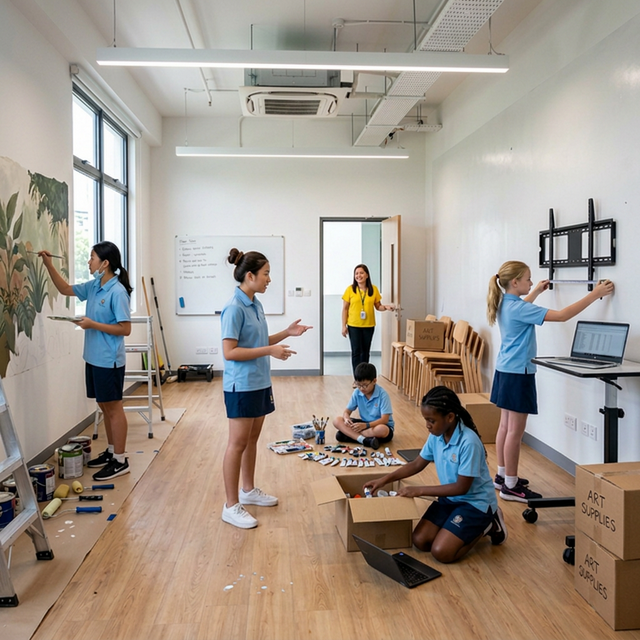
In one workshop, a group of students might be setting up a new studio space inside the learning center.
One student measures the layout of the room. Another manages materials and inventory on a laptop. A younger student organizes supplies while another helps assemble equipment.
Leading the activity is one of the oldest students in the learning center — a seventeen-year-old preparing to graduate. Just a few years earlier, he was doing the same tasks the younger students are now learning. Today, he guides them, coordinates decisions, and ensures the project moves forward.
Overseeing the group is a learning coach, working closely with five students — reflecting Vinzala's intentionally small 1:5 learning coach-to-student ratio. This structure allows students to take real ownership of their work while still receiving guidance when it matters most.
What may look like a simple project is actually a powerful learning moment.
Mathematics appears when students calculate measurements and materials. Technology appears when they track plans and resources. Science appears when they test ideas and adjust their approach.
Students practice something even more important: leadership, responsibility, patience, and collaboration. They also learn how to navigate disagreements, resolve conflicts, and work through challenges together — skills that are essential in the real world.
Rather than learning subjects in isolation, students experience how knowledge connects across disciplines.
Over time, these experiences build something traditional classrooms rarely provide — confidence in applying what they know in the real world.
This is how Vinzala students gain meaningful experience while they are still learning — not only after they leave school.
Workshops may include:
- Robotics and engineering projects
- Scientific investigations and experiments
- Creative design and media production
- AI-native product building, automation, and digital systems
- Interdisciplinary problem-solving challenges
- Community and practical life skills projects
Parent Intelligence & Learning Visibility
Vinzala doesn't just show parents what their child is learning — it reveals how they are growing, thinking, and discovering who they are becoming.